Lost in Normandy’s Forgotten Stone: Where Hidden Architecture Whispers Secrets
Have you ever walked through a place that feels like a secret? Normandy isn’t just about beaches and history books—its quiet villages hide breathtaking architecture, centuries old, tucked behind ivy and time. I stumbled upon stone chapels, half-timbered cottages, and fortified farms no guidebook mentioned. This is not tourism—it’s discovery. And the real magic? It’s all in the details etched into weathered walls and crooked beams. These structures, standing quietly for generations, tell stories of resilience, craftsmanship, and daily life shaped by land and seasons. Beyond the well-trodden paths of D-Day memorials lies a deeper, more intimate Normandy—one built not for war, but for living.
Beyond D-Day: Normandy’s Quiet Architectural Soul
When most travelers think of Normandy, images of Omaha Beach or the American Cemetery come to mind—solemn, powerful, and rightly honored. Yet this region’s architectural soul extends far beyond its wartime legacy. Across its rolling countryside, hidden in the folds of green hills and winding hedgerows, stand centuries-old buildings that speak of a quieter, enduring history. These are not grand palaces or royal estates, but the homes, farms, and places of worship built by ordinary people with extraordinary care. Constructed from local stone, oak timber, and thatch, these structures reflect a deep connection to the land and a tradition of self-reliance that defined rural Norman life for generations.
Unlike the ornate châteaux of central France, Normandy’s architecture favors function over flourish. Its beauty lies in subtlety—the curve of a timber joint, the texture of weathered cob walls, the way a thatched roof slopes gently to meet the earth. These buildings were not designed to impress visitors but to withstand wind, rain, and time. Many date back to the 15th and 16th centuries, built during periods of relative peace when farming communities thrived. Manor houses with thick stone walls and small windows once housed minor nobility, while granaries and dovecotes served practical roles in agricultural life. The dovecote, or *pigeonnier*, was once a symbol of status, as only landowners could legally keep pigeons, whose droppings fertilized fields and whose meat supplemented diets.
What makes these structures significant today is not just their age, but their authenticity. Many remain in use, maintained by families who value heritage as much as utility. This continuity offers a rare glimpse into a way of life that has changed little in essence, even as the world around it has transformed. To walk through these villages is to step into a living archive, where architecture is not frozen in time but continues to evolve with care and respect. By shifting focus from battlefields to barns, from memorials to manor houses, travelers can uncover a Normandy that is not only historic but deeply human.
Half-Timbered Villages: The Living Postcards of Normandy
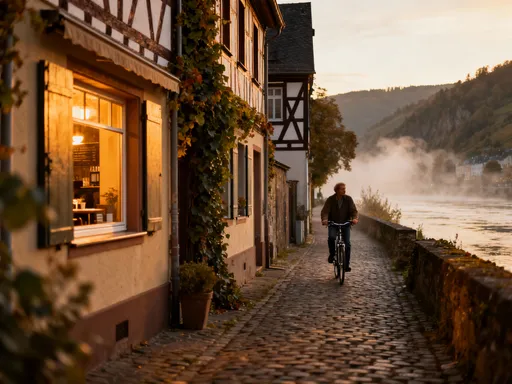
Among the most enchanting expressions of Norman architecture are the half-timbered villages that dot the Pays d’Auge and the Cotentin Peninsula. These towns look like illustrations from a storybook—timber frames painted in soft blacks and browns crisscross overhead, walls filled with white plaster, and roofs thick with golden thatch. Streets are narrow, winding, and often lined with geraniums in summer, their blooms spilling from window boxes like bursts of color. Beuvron-en-Auge, frequently listed among France’s most beautiful villages, is a prime example. Its central square, ringed by centuries-old inns and houses, feels timeless, not because it’s frozen in the past, but because life here still unfolds at a human pace.
The half-timbered, or *colombage*, technique dates back to the Middle Ages and was widely used in Normandy due to the abundance of oak forests. Builders would construct a framework of heavy timber beams, leaving gaps to be filled with wattle and daub—a mixture of woven branches, clay, straw, and manure. This method provided excellent insulation and allowed for flexibility in the structure, important in a region prone to shifting soils and strong winds. The exposed beams were not merely decorative; they were structural, bearing the weight of the roof and upper floors. Over time, as prosperity grew, homeowners began to embellish their facades with carved motifs—roses, initials, even biblical scenes—turning functional buildings into personal statements.
What sets these villages apart from mere tourist attractions is their authenticity. Unlike reconstructed historic districts, places like Barfleur and Touques remain inhabited. Children walk to school past 400-year-old houses, and local bakers open their shops each morning in buildings that once served as merchant halls. This continuity is protected by strict preservation laws and active community efforts. In Beuvron-en-Auge, for instance, any renovation must follow traditional methods and materials, ensuring that modern interventions do not disrupt the village’s character. Local artisans, from thatchers to timber framers, are in high demand, keeping centuries-old skills alive. As a result, these villages do not feel like museum exhibits but like homes—lived-in, loved, and carefully preserved.
Fortified Farmsteads: The Norman Strongholds You’ve Never Heard Of
Scattered across the countryside of Calvados and Orne are some of Normandy’s most intriguing yet overlooked structures—the *fermes fortifiées*, or fortified farmsteads. Built primarily between the 14th and 16th centuries, these complexes were more than just farms; they were miniature fortresses designed to protect families, livestock, and harvests during times of conflict. Surrounded by high stone walls, often topped with slate or thatch, these estates feature iron gates, watchtowers, and sometimes even moats. Inside, the layout is both practical and strategic: living quarters, stables, barns, and storage areas are arranged around a central courtyard, allowing residents to move safely between buildings without stepping outside the perimeter.
The need for such strongholds arose from Normandy’s turbulent history. During the Hundred Years’ War and later regional conflicts, marauding bands often raided the countryside, seizing food and livestock. A fortified farm could withstand a siege for weeks, with thick stone walls resisting fire and arrows, and internal wells providing water. The towers, typically located at corners or gatehouses, allowed lookouts to spot approaching threats from miles away. Some farms even included small chapels, emphasizing the spiritual as well as physical security of the household. One well-preserved example can be found near Thaon, where a 15th-century farm still stands with its original gatehouse and defensive turret intact, now serving as a private residence.
Today, many of these farmsteads have been restored and repurposed. Some operate as bed and breakfasts, offering guests a rare opportunity to sleep within ancient stone walls. Others have been converted into event spaces or cultural centers, hosting exhibitions on rural life and heritage craftsmanship. Their survival is a testament to the durability of Norman construction and the value placed on preservation. What’s remarkable is how seamlessly these medieval structures integrate into modern life. A family may heat their home with central heating, yet still walk through a 600-year-old arched doorway each morning. These farmsteads are not relics of war, but symbols of resilience—proof that safety, community, and self-sufficiency were once, and can still be, built into the very walls of a home.
Stone Chapels in the Mist: Sacred Spaces Off the Beaten Path
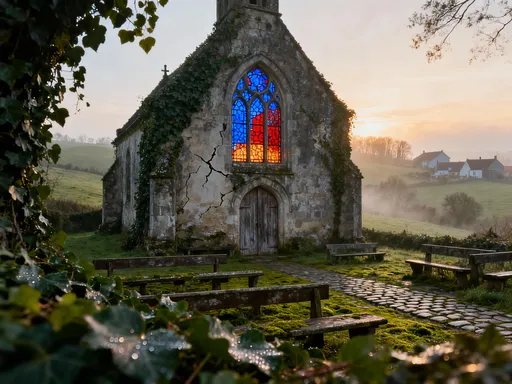
Deep in the bocage—the patchwork of small fields divided by dense hedgerows—lie quiet sanctuaries that time seems to have forgotten. Small stone chapels, often unnamed and unmarked on maps, stand at crossroads, atop gentle hills, or beside forgotten footpaths. These modest places of worship were once central to rural spiritual life, serving as sites for local processions, blessings of the fields, and quiet prayer. Unlike the towering cathedrals of cities, these chapels are intimate, their scale matching the communities that built them. Many are no larger than a farmer’s shed, with simple rounded arches, small stained-glass windows, and roofs covered in moss and lichen.
One such chapel, tucked near the village of Sainte-Marguerite-de-Viette, dates back to the 12th century. Its walls, built from rough-hewn Caen stone, bear the marks of centuries of weather. Inside, the air is cool and still, the light filtered through a single stained-glass panel depicting the Virgin Mary. There is no electricity, no signage, only a small wooden altar and a few weathered benches. Locals still visit, especially during Rogation Days in May, when blessings are offered for the growing season. These visits are not tourist performances but genuine acts of tradition, linking the present to a spiritual past that remains quietly alive.
Another example lies near the forest of Cerisy, where a chapel dedicated to Saint Eloi stands at a fork in an old drovers’ road. Once used by shepherds seeking protection for their flocks, it now attracts hikers and pilgrims walking the lesser-known trails of western Normandy. The chapel’s survival is due in part to its isolation—too remote for large-scale development, yet accessible enough for occasional care. Volunteers from nearby parishes periodically clean the interior and repair the roof, ensuring that these sacred spaces do not vanish into silence. To visit one is to experience a different kind of reverence—one not announced by bells or crowds, but felt in the stillness between stones and the soft rustle of ivy on ancient walls.
Abbeys in Ruin and Revival: From Silence to Song
Normandy’s spiritual heritage is perhaps best embodied in its abbeys—some magnificently restored, others left in poetic decay. While Mont-Saint-Michel draws millions each year, quieter sites like Jumièges, Lessay, and Mondaye offer more contemplative experiences. These monastic complexes, founded as early as the 7th century, were once centers of learning, agriculture, and faith. Their ruins speak of both grandeur and fragility, with towering arches rising from grassy fields, their stained glass long gone, their roofs open to the sky. Yet even in ruin, they possess a powerful presence, shaped by light, shadow, and the slow return of nature.
Jumièges Abbey, nestled along the Seine, is often called the most beautiful ruin in France. Founded in 654, it flourished for centuries before falling into decline during the Wars of Religion and the French Revolution. Today, its twin bell towers still dominate the skyline, their Gothic arches framing views of the river. Visitors walk among the remnants of the nave and cloister, where silence is broken only by birdsong and the whisper of wind through stone. Restoration efforts have stabilized the structure, but deliberately avoided full reconstruction, preserving the sense of history in its incomplete form. Information panels, written in both French and English, provide context without overwhelming the experience.
In contrast, Lessay Abbey in the Manche department has undergone careful restoration. Its Romanesque church, dating to the 11th century, now hosts regular concerts and religious services. The acoustics, enhanced by stone vaults and minimal modern additions, create a haunting resonance, especially during Gregorian chant performances. Here, revival does not erase history but reactivates it—allowing the space to fulfill its original purpose in a modern context. These abbeys, whether preserved as ruins or restored to use, remind us that spirituality is not confined to active worship but can also reside in memory, architecture, and the passage of time.
The Craft Behind the Walls: Traditional Materials and Techniques
The enduring beauty of Norman architecture is inseparable from the materials and methods used to build it. Builders relied entirely on what the land provided: Caen stone, known for its fine grain and pale gold color; oak timber, strong and resistant to rot; river clay for cob walls; and reeds from marshes for thatching. These materials were not chosen for aesthetics alone but for their suitability to the region’s climate—damp, windy, and often harsh. The combination of stone foundations with timber frames created structures that could settle without cracking, while thick thatched roofs provided superior insulation compared to tile.
Construction followed seasonal rhythms. Timber was felled in winter, when sap levels were low, reducing the risk of warping. Thatching took place in late summer, after reeds were harvested and dried. Cob walls—made from a mixture of clay, straw, and water—were built up in layers, each allowed to dry before the next was added. This labor-intensive process required skilled hands and communal effort, often involving entire villages in the raising of a new barn or home. These techniques were passed down orally and through apprenticeship, forming a living tradition that persisted for centuries.
Today, restoration projects continue to rely on these methods. Modern builders trained in traditional crafts work alongside historians to repair ancient structures using authentic materials. In Pont-l'Évêque, a restoration workshop specializes in timber framing, training a new generation in joint techniques that predate nails. Similarly, thatchers from the Cotentin Peninsula travel across France to repair historic roofs, using hand tools and techniques unchanged for generations. This commitment to authenticity ensures that repairs do not erase history but extend it. The craft behind the walls is not a relic—it is a living practice, quietly preserving the soul of Norman architecture.
How to Find These Hidden Gems: A Traveler’s Guide
Discovering Normandy’s hidden architecture requires a shift in mindset—from sightseeing to wandering, from speed to slowness. These treasures are rarely found along major highways or listed in mainstream travel apps. Instead, they reveal themselves to those who explore on foot, by bicycle, or with the help of local knowledge. The key is to move beyond the well-marked attractions and embrace the unexpected. Regional tourist offices, especially in smaller towns like Vire or Villedieu-les-Poêles, often provide detailed maps of heritage trails and walking routes that lead to obscure chapels, old mills, and preserved farmsteads.
Hiring a local guide can transform a casual visit into a meaningful journey. Many are historians, architects, or lifelong residents who know where to find the unnamed chapel behind a field of wheat or the 16th-century dovecote hidden in a private orchard. Some offer themed tours—on timber framing, religious heritage, or rural life—that provide context often missing from guidebooks. Walking tours in villages like Beuvron-en-Auge or Barfleur not only showcase architecture but also introduce travelers to shopkeepers, bakers, and artisans who contribute to the community’s living heritage.
For the independent traveler, cycling is an ideal way to explore. The Véloscénie route, which runs from Paris to Mont-Saint-Michel, passes through picturesque Norman countryside and includes detours to historic sites. Equally rewarding are the smaller, unsigned paths that follow old pilgrim trails or farm tracks. These routes often lead to places untouched by tourism—quiet lanes where a crumbling stone wall might reveal a carved date from the 1400s, or a hedge-lined path opens onto a forgotten chapel. The joy lies not in checking off landmarks but in the act of discovery itself.
Respect is essential. Many of these structures are on private land or still in use. Visitors should never trespass, climb on walls, or disturb wildlife. A quiet presence, a respectful distance, and a willingness to observe rather than intrude allow these places to remain what they are—living parts of a landscape, not exhibits. Carrying a simple notebook to sketch details or record impressions can deepen the experience, turning a walk into a personal archive of memory and observation.
Architecture That Breathes History
Normandy’s hidden buildings are not relics frozen in time—they are living testaments to craft, community, and quiet endurance. To walk among them is to hear whispers of the past, not in grand speeches, but in the curve of a beam, the moss on a stone, the way light falls through a broken window. These structures were built to serve, to protect, and to last. They reflect a way of life rooted in the rhythms of nature, the strength of tradition, and the dignity of labor. In seeking them, we do not merely observe history—we feel it in our bones.
The true value of these places lies not in their rarity, but in their authenticity. They have not been polished for tourists or reconstructed for spectacle. They stand as they are—weathered, imperfect, and deeply human. In a world that often prioritizes speed and novelty, they invite us to slow down, to look closely, and to listen. They remind us that beauty can be found in simplicity, and that history is not always loud. Sometimes, it speaks in silence, in stone, in the quiet resilience of a roof that has sheltered generations. And sometimes, that is the most powerful journey of all.